I have nooo idea what the point of this lecture was, to be perfectly honest. The lecturer though did remind me very strongly of someone. But I couldn't put my finger on who. It's STILL frustrating me, a full day after. He was entertaining though... Back to the lecture though. I think there might've been a point after all, I'm not sure ;)
We were shown some examples of visual data representation, which was followed by lots of chit chat about the "Dot Com Boom" and its subsequent crash. Some chick went from being worth $18 to 5 million and then back to $19 in the space of a year. Sad. She should've got out with her 5 mil. I know I totally would've been smart enough to do that XD
AOL rose and fell, as did Yahoo, who's now partnering with ol' Bill Gates to compete with Google, just like Myspace keeps (sadly) trying to update itself to compete with Facebook. Facebook's better. No reason why, maybe it's just cos for some reason I don't see as many skanky stupid 16-year-olds on there? They are catching onto the new "trend" though, and I don't like it :( As for Twitter, you know what my News&Politics tutor said about it? It's like having a lot of birds twittering in the background. What do you do to birds twittering in the background? You block them out. Which is eventually what's going to happen to Twitter. THANK GOD. And while I'm on the topic of Twitter, I would like to express my PROTEST at having had to get an account for my N&P class. I hate Twitter. And I'm not too fond of N&P either.
Thursday, August 27, 2009

Thursday, August 20, 2009
Lecture 4.0: Big To Small
Another run down of yet another lecture. Again, this will be brief.
We were **educated** on early cinematography, timelines and such were incorporated, and how the television came in and no one thought it'd be that big, but as it turns out... it was. And Hollywood jumped on the band wagon after a while, and then TV became this huggeeee thing. I honestly don't see the big deal. I could live without TV. That's what the internet is for hahaha. Which reminds me, there was also talk of how the internet is the "new" TV, and Hollywood just isn't keeping up, tsk tsk. The internet is, would you believe, a great medium for amateur film-makers to "express" themselves. You get a lot of crap, but somewhere in the rough, you do find a diamond every now and then. Like this Star Wars parody short film made quite a while ago I think. Uber amusing.
We were **educated** on early cinematography, timelines and such were incorporated, and how the television came in and no one thought it'd be that big, but as it turns out... it was. And Hollywood jumped on the band wagon after a while, and then TV became this huggeeee thing. I honestly don't see the big deal. I could live without TV. That's what the internet is for hahaha. Which reminds me, there was also talk of how the internet is the "new" TV, and Hollywood just isn't keeping up, tsk tsk. The internet is, would you believe, a great medium for amateur film-makers to "express" themselves. You get a lot of crap, but somewhere in the rough, you do find a diamond every now and then. Like this Star Wars parody short film made quite a while ago I think. Uber amusing.
Tuesday, August 18, 2009
SCAVENGER HUNT! (Ugh)
Not using google or wikipedia, here are the answers to some random questions. This is the task for this week's tutorial, seriously, I wouldn't be doing this otherwise... Although, I did already know the answer to number 3. Not that I'm admitting that.
1. What is the weight of the world's biggest pumpkin? How long did it take to grow?
1689 pounds. Didn't say how long it took to grow. (H-Ref 1)

2. Best (quickest, fastest) way to contact Lily Allen?
0416 566 165. Lol. ;) Alternatively, Facebook or Myspace (http://www.myspace.com/lilymusic) (H-Ref 2)

3. How long is a giraffe's tongue?
21 inches. That is totally from my own general knowledge. Hah. (H-Ref 3)
Look at those things go!
4. Define "glycomics" and in your own words, what does it really mean? What does the term seagull manager" refer to?
"Glycomics involves the study of the glycans and glycan-binding proteins in various biological systems, and the design of novel drugs and vaccines." (H-ref 4.1) In my own words, it means a lot of mumbo jumbo. Hah. No really, it sounds far too complicated for me to fathom without someone explaining it to me in dumbed down terms. Maybe the study of sugars or carbs or something like that yeah?
As for "seagull manager" I take it to mean "a manager who only interacts with employees to criticize their work or when a problem arises." (H-ref 4.2)
5. What was David Cronenberg's first feature film? Which of his films had "Blondie" in it?
Transfer (1966) and Blondie was in Videodrome (H-Ref 5)
6. When was the original "Hackers Manifesto" written?
January 8, 1986. (H-Ref 6) But who cares about that? When I hear "Hackers" I think of that movie from years ago, I think it was 1996 actually, with Angelina Jolie at a time when she had short hair. She's definitely had more attractive hair cuts. I don't think I ever watched that movie... any volunteers? I read the book though, and that was good. I think the movie would be better though, it has Angelina Jolie in it after all. She ended up marrying the lead guy of that movie, in fact, but dumped him for a (female) supermodel. Hehe, nicely done.
Heh, close enough. ;)
7. Why do phone numbers in Hollywood films always start with 555?
Hollywood films have been restricted a set of 555 numbers so that apparently no one gets millions of prank phone calls asking for "God" (Bruce Almighty anyone?). These particular 555 numbers don't actually exist or some such drivvel. (H-Ref 7)
8. Cheapest form of travel from Gold Coast to Sydney?
Hitchhiking. Otherwise, $59 by plane. I'm assuming that flying would be the cheapest way because unless you're going to hitchhike it, you'd have to pay for petrol or for a bus ticket or something and yeah. Don't argue with me. (H-Ref 8)
9. Top song in the Australian Pop Charts this week in 1965?
Normie Rowe & The Playboys (H-Ref 9)
10. Which Brisbane band includes Stephen Stockwell on vocals and keyboards?
The Black Assassins. I stole it off someone else's blog so sue me. Technically, I didn't use Google or wiki. (H-Ref 10)

Bibliography
H-ref 1 - http://pumpkinnook.com/giants/giantpumpkins.htm
Found via - Yahoo
H-ref 2 - General Knowledge
H-ref 3 - General Knowledge
H-ref 4.1 - http://www.griffith.edu.au/science/institute-glycomics
Found via - Yahoo
H-ref 4.2 - http://www.wordspy.com/words/seagullmanager.asp
Found via - Yahoo
H-ref 5 - http://www.imdb.com/name/nm0000343/
H-ref 6 - http://www.mithral.com/~beberg/manifesto.html
Found via - Dogpile
H-ref 7 - http://thewhyoftheweb.blogspot.com/2009/05/immersive-entertainment-and-damn-555.html
Found via - Ask Jeeves
H-ref 8 - http://www.flightcentre.com.au
H-ref 9 - http://www.poparchives.com.au/feature.php?id=101
Found Via - Ask Jeeves
H-ref 10 - http://blackassassins.net/
Found via - Dogpile and someone else's blog
1. What is the weight of the world's biggest pumpkin? How long did it take to grow?
1689 pounds. Didn't say how long it took to grow. (H-Ref 1)

2. Best (quickest, fastest) way to contact Lily Allen?
0416 566 165. Lol. ;) Alternatively, Facebook or Myspace (http://www.myspace.com/lilymusic) (H-Ref 2)

3. How long is a giraffe's tongue?
21 inches. That is totally from my own general knowledge. Hah. (H-Ref 3)
Look at those things go!
4. Define "glycomics" and in your own words, what does it really mean? What does the term seagull manager" refer to?
"Glycomics involves the study of the glycans and glycan-binding proteins in various biological systems, and the design of novel drugs and vaccines." (H-ref 4.1) In my own words, it means a lot of mumbo jumbo. Hah. No really, it sounds far too complicated for me to fathom without someone explaining it to me in dumbed down terms. Maybe the study of sugars or carbs or something like that yeah?
As for "seagull manager" I take it to mean "a manager who only interacts with employees to criticize their work or when a problem arises." (H-ref 4.2)
5. What was David Cronenberg's first feature film? Which of his films had "Blondie" in it?
Transfer (1966) and Blondie was in Videodrome (H-Ref 5)
6. When was the original "Hackers Manifesto" written?
January 8, 1986. (H-Ref 6) But who cares about that? When I hear "Hackers" I think of that movie from years ago, I think it was 1996 actually, with Angelina Jolie at a time when she had short hair. She's definitely had more attractive hair cuts. I don't think I ever watched that movie... any volunteers? I read the book though, and that was good. I think the movie would be better though, it has Angelina Jolie in it after all. She ended up marrying the lead guy of that movie, in fact, but dumped him for a (female) supermodel. Hehe, nicely done.
Heh, close enough. ;)
7. Why do phone numbers in Hollywood films always start with 555?
Hollywood films have been restricted a set of 555 numbers so that apparently no one gets millions of prank phone calls asking for "God" (Bruce Almighty anyone?). These particular 555 numbers don't actually exist or some such drivvel. (H-Ref 7)
8. Cheapest form of travel from Gold Coast to Sydney?
Hitchhiking. Otherwise, $59 by plane. I'm assuming that flying would be the cheapest way because unless you're going to hitchhike it, you'd have to pay for petrol or for a bus ticket or something and yeah. Don't argue with me. (H-Ref 8)
9. Top song in the Australian Pop Charts this week in 1965?
Normie Rowe & The Playboys (H-Ref 9)
10. Which Brisbane band includes Stephen Stockwell on vocals and keyboards?
The Black Assassins. I stole it off someone else's blog so sue me. Technically, I didn't use Google or wiki. (H-Ref 10)

Bibliography
H-ref 1 - http://pumpkinnook.com/giants/giantpumpkins.htm
Found via - Yahoo
H-ref 2 - General Knowledge
H-ref 3 - General Knowledge
H-ref 4.1 - http://www.griffith.edu.au/science/institute-glycomics
Found via - Yahoo
H-ref 4.2 - http://www.wordspy.com/words/seagullmanager.asp
Found via - Yahoo
H-ref 5 - http://www.imdb.com/name/nm0000343/
H-ref 6 - http://www.mithral.com/~beberg/manifesto.html
Found via - Dogpile
H-ref 7 - http://thewhyoftheweb.blogspot.com/2009/05/immersive-entertainment-and-damn-555.html
Found via - Ask Jeeves
H-ref 8 - http://www.flightcentre.com.au
H-ref 9 - http://www.poparchives.com.au/feature.php?id=101
Found Via - Ask Jeeves
H-ref 10 - http://blackassassins.net/
Found via - Dogpile and someone else's blog
Sunday, August 16, 2009
Shots As Words
So, for "homework" we had to go home and watch a movie. Well, I went and watched My Sister's Keeper. Bit sappy for me, I think I fell asleep from boredom for a while.
Oh, and then, we had to pick a show and get shots as words from it or whatever. So here they are?
Smallville, cos I conveniently had them in another post. Hah.
Who - look, it's the ever so sexy Lana Lang!
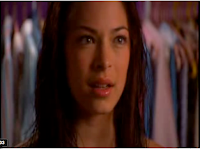
What - Chloe smashing Lana a good one, always good to see a bitch fight ;)

When - since its in the school, I'd assume it's school time?

Where - oooh girl's dressing room. Nice.

Oh, and then, we had to pick a show and get shots as words from it or whatever. So here they are?
Smallville, cos I conveniently had them in another post. Hah.
Who - look, it's the ever so sexy Lana Lang!

What - Chloe smashing Lana a good one, always good to see a bitch fight ;)

When - since its in the school, I'd assume it's school time?

Where - oooh girl's dressing room. Nice.

Saturday, August 15, 2009
Lecture 3.0: Cine Speak
So I was meant to do this the week of the lecture. This was Week 3's lecture summary, here goes:
Firstly, we discussed the 8 different types of shots used in photography and filming.
I found out that we can use shots as words. Like, the CU answers the "who?" question by providing us with a close up of the main person(s) in that scene and the LS generally answers the "where?" question at the beginning of where they are. Go figure.
There was also talk of head room, talking room, the 180 rule and the rule of thirds. All pretty simple stuff, I'm sure you can figure it out on your own... or can you? Haha.
Inserts and cutaways provide extra tidbits of info inside/outside the screen. They can be pretty helpful I'd assume. Another interesting point, that I totally never would of thought of on my own (mainly due to the fact that I DON'T CARE enough to think of it in the first place) is that every shot needs to drive the narrative forward.
And there you have it: Lecture 3.0
There's another couple of minutes of your life I just stole that you'll never, ever get back. But wait, if I stole them, does that mean my life lasts those couple of minutes longer? Heheheheh.
Firstly, we discussed the 8 different types of shots used in photography and filming.
I found out that we can use shots as words. Like, the CU answers the "who?" question by providing us with a close up of the main person(s) in that scene and the LS generally answers the "where?" question at the beginning of where they are. Go figure.
There was also talk of head room, talking room, the 180 rule and the rule of thirds. All pretty simple stuff, I'm sure you can figure it out on your own... or can you? Haha.
Inserts and cutaways provide extra tidbits of info inside/outside the screen. They can be pretty helpful I'd assume. Another interesting point, that I totally never would of thought of on my own (mainly due to the fact that I DON'T CARE enough to think of it in the first place) is that every shot needs to drive the narrative forward.
And there you have it: Lecture 3.0
There's another couple of minutes of your life I just stole that you'll never, ever get back. But wait, if I stole them, does that mean my life lasts those couple of minutes longer? Heheheheh.
Tuesday, August 11, 2009
Language of the Screen
Shot composition stuff. Exciting, ne?
ECU - EXTREME CLOSE UP - shows part of an object in extremely close detail. (H-Ref 1)
 BCU - Big Close Up -Very intimate shot. Great in dramatic moments when the actor is giving their all. (H-ref 4)

CU - Close Up -You can see the look of concentration in a shot that is "full face". Sometimes used for interviews - especially when things are getting personal. (H-ref 4)
MCU - Medium Close Up -Between CU and MS. Cuts off a person around the "breast pocket" (H-Ref 4)

MS -Mid Shot - shows more detail than a long shot, but not as much of a close-up (H-Ref 3)
MLS - Medium Long Shot - The mid shot cuts off at the waist. It is a good shot to introduce people to your audience. You get a good image of the subject and their surroundings. (H-Ref 4)
LS - Long Shot -The long shot takes in the whole height of the person. It doesn't show as much background as the VLS but it does show enough to know the subject's location. (H-Ref 4)
WS - Wide Shot - covers the action of the scene in a wide or panoramic view. (H-Ref 2)

Aww pretty kitty... er... yeah...
And now, here's me killing time, with a guest appearance from Butters:
Bibliography
H-Ref 1 - English Online
english.unitecnology.ac.nz/resources/units/piano/film_terms.html
H-Ref 2 -Video Boot Camp
www.sfusd.k12.ca.us/schwww/sch634/medialit/video/camera.html
H-Ref 3 - Australian Screen
http://australianscreen.com.au/glossary/
H-Ref 4 - Shot Sizes
http://www.urbanfox.tv/creative/shotsizes.html
ECU - EXTREME CLOSE UP - shows part of an object in extremely close detail. (H-Ref 1)
 BCU - Big Close Up -Very intimate shot. Great in dramatic moments when the actor is giving their all. (H-ref 4)
CU - Close Up -You can see the look of concentration in a shot that is "full face". Sometimes used for interviews - especially when things are getting personal. (H-ref 4)
MCU - Medium Close Up -Between CU and MS. Cuts off a person around the "breast pocket" (H-Ref 4)

MS -Mid Shot - shows more detail than a long shot, but not as much of a close-up (H-Ref 3)
MLS - Medium Long Shot - The mid shot cuts off at the waist. It is a good shot to introduce people to your audience. You get a good image of the subject and their surroundings. (H-Ref 4)
LS - Long Shot -The long shot takes in the whole height of the person. It doesn't show as much background as the VLS but it does show enough to know the subject's location. (H-Ref 4)
WS - Wide Shot - covers the action of the scene in a wide or panoramic view. (H-Ref 2)

Aww pretty kitty... er... yeah...
And now, here's me killing time, with a guest appearance from Butters:
Bibliography
H-Ref 1 - English Online
english.unitecnology.ac.nz/resources/units/piano/film_terms.html
H-Ref 2 -Video Boot Camp
www.sfusd.k12.ca.us/schwww/sch634/medialit/video/camera.html
H-Ref 3 - Australian Screen
http://australianscreen.com.au/glossary/
H-Ref 4 - Shot Sizes
http://www.urbanfox.tv/creative/shotsizes.html
History of Computing and the Internet
So this here's a pretty basic timeline of the history of computing. You're excited, I can tell.
* Abacus: c. 3000 BC
* Transistors: 1947
* Apple II: 1977
* IBM PC: 1981
* World Wide Web: 1991
(H-Ref 1)
Told you it was brief. Okay, so maybe a little bit more information is needed about the "big" events in history, yeah?
Alan Turing, born in England in 1912, did most of the serious work for the development of the computer. After the War, Turing investigated "programming, neural nets, and the prospects for artificial intelligence." (H-Ref 2)
In the 1950's, IBM produced the first commercially available computers. Impressive, huh? Not as impressive as the gigantic, monstrous machines that they were though. Ugly, but impressive.

Steve Jobs and Steve Wozniak got together to create that well-loved company we all know as Apple. They made this "thing" (I'd hardly call it a computer) called the Apple I - a primitive machine with a single circuit board, no case and no keyboard. It cost $USA666.60. Oh, the devil's number, could it be a sign? They came back with the Apple II after the flop of the Apple I, which basically made them a fortune by 1978. (H-Ref 2)

As for the internet... well...
*1969: something known as the ARPANET was brought online. Basically, it allowed computers to share information with each other across military and scientific fields.
*1972: Ray Tomlinson adapted e-mail for ARPANET
*1981: BITNET connected IBM mainframes around the educational community and the world to provide mail services
*1986: the National Science Foundation funded NSFNet as a cross country 56 Kbps backbone for the Internet
*1991: the first really friendly interface to the Internet was developed at the University of Minnesota.
*1998: Bill Gates releases Windows '98 with the internet browser well intergrated into the system
*Today: Wireless has been in for a while; internet speed is phenomenal when looking back.
(H-Ref 3)
Bibliography
H-Ref 1 - Triumph of the Nerds
http://www.pbs.org/nerds/timeline/
H-Ref 2- NCT 09 GC Blog
http://nct09-gc.blogspot.com/
H-Ref 3 - A Brief History of the Internet
http://www.walthowe.com/navnet/history.html
H-Ref 4 - Big Computers
http://ed-thelen.org/comp-hist/Shustek/37-Xerox-Alto.gif
H-Ref 5 - First Apple Computer
http://www.vintage-computer.com/images/apple2e.jpg
* Abacus: c. 3000 BC
* Transistors: 1947
* Apple II: 1977
* IBM PC: 1981
* World Wide Web: 1991
(H-Ref 1)
Told you it was brief. Okay, so maybe a little bit more information is needed about the "big" events in history, yeah?
Alan Turing, born in England in 1912, did most of the serious work for the development of the computer. After the War, Turing investigated "programming, neural nets, and the prospects for artificial intelligence." (H-Ref 2)
In the 1950's, IBM produced the first commercially available computers. Impressive, huh? Not as impressive as the gigantic, monstrous machines that they were though. Ugly, but impressive.
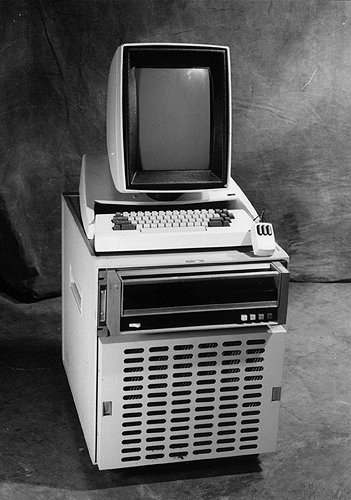
Steve Jobs and Steve Wozniak got together to create that well-loved company we all know as Apple. They made this "thing" (I'd hardly call it a computer) called the Apple I - a primitive machine with a single circuit board, no case and no keyboard. It cost $USA666.60. Oh, the devil's number, could it be a sign? They came back with the Apple II after the flop of the Apple I, which basically made them a fortune by 1978. (H-Ref 2)

As for the internet... well...
*1969: something known as the ARPANET was brought online. Basically, it allowed computers to share information with each other across military and scientific fields.
*1972: Ray Tomlinson adapted e-mail for ARPANET
*1981: BITNET connected IBM mainframes around the educational community and the world to provide mail services
*1986: the National Science Foundation funded NSFNet as a cross country 56 Kbps backbone for the Internet
*1991: the first really friendly interface to the Internet was developed at the University of Minnesota.
*1998: Bill Gates releases Windows '98 with the internet browser well intergrated into the system
*Today: Wireless has been in for a while; internet speed is phenomenal when looking back.
(H-Ref 3)
Bibliography
H-Ref 1 - Triumph of the Nerds
http://www.pbs.org/nerds/timeline/
H-Ref 2- NCT 09 GC Blog
http://nct09-gc.blogspot.com/
H-Ref 3 - A Brief History of the Internet
http://www.walthowe.com/navnet/history.html
H-Ref 4 - Big Computers
http://ed-thelen.org/comp-hist/Shustek/37-Xerox-Alto.gif
H-Ref 5 - First Apple Computer
http://www.vintage-computer.com/images/apple2e.jpg
Subscribe to:
Posts (Atom)